
Cultural Heritage Interpretation
Gruppo CNR ISPC

The CNR ISPC Cultural Heritage Interpretation Group studies how cultural heritage is perceived, interpreted, and enhanced by different components of society, both in the present and through the historical evolution of its meanings.
The group promotes activities aimed at stimulating critical dialogue on the meaning of heritage, its value, and how these concepts change over time, space, communities, and cultures.
The Cultural Heritage Interpretation Group is dedicated to the study of the perceptions, representations, and meanings of cultural heritage among various stakeholder communities: the general public, local communities, professional communities of practice (conservation, archaeology, and museology professionals), cultural institutions, and political decision-making bodies. Within each of these groups, further categories can be identified (age groups, level of experience, type of training, etc.) for which understanding perceptions may be important.
Indeed, it is only through a deep understanding of these fundamental perspectives that it becomes possible to establish - or at least encourage - dialogue among distinct communities and groups on cultural heritage issues. One of the foundational aspects is the adoption of a perspective that intertwines synchrony and diachrony: on one hand, it investigates contemporary perceptions of heritage; on the other, it historically reconstructs how such perceptions have transformed over time.


Mission and Amis
The mission of the Culturale Heritage Interpretation Group is to bridge the gap between academic/professional heritage research and public understanding of it, rooted in the belief that both approaches are value-creating and that it is necessary to bring them into dialogue.
In particular, the Group aims to achieve this through:
- Diachronic research on heritage perception: investigating what cultural heritage has represented and represents for different target audiences, utilizing qualitative, quantitative, and hybrid methodologies from the social sciences.
- Analysis of interpretative processes: understanding how institutions, professional communities (in the fields of heritage, tourism, media, and others), and other publics construct and negotiate the meanings of heritage, thereby contributing to the definition of new paradigms for its democratic and participatory management.
- Translation and communication: developing evidence-based strategies to communicate cultural heritage effectively, connecting scientific knowledge, professional practices, and the interpretative needs of different audiences to foster conscious dialogue and a broader understanding of cultural heritage.
- Impact on research and practice: providing data and theoretical frameworks that can improve both research and professional practice.
Research topics
Studies on cultural heritage perception
Large-scale surveys on public perceptions of tangible and intangible cultural heritage | Intergenerational, intercultural, and socio-demographic comparative analysis | Study of the psychological and cognitive mechanisms underlying the attribution of heritage value.
History of heritage perceptions
Diachronic analysis of the evolution of heritage-related concepts | Study of changes in the methods of heritage interpretation and enhancement across different historical-political contexts | Analysis of transformations in public perception through historical sources | Mapping the epistemological breaks that have redefined what we consider heritage | Study of the historical roots of current UNESCO criteria and national institutions | How the narrative of value attribution across different eras can enrich the levels of storytelling surrounding the asset itself.
Communities of practice and knowledge transfer
Ethnographies of professional heritage communities | Analysis of the processes of specialized knowledge construction and its transmission | Study of the tensions between expert knowledge and local/community knowledge | Analysis of educational practices in lower and upper secondary schools regarding heritage-related disciplines.
Interpretation and communication strategies
Development of evidence-based models for heritage interpretation | Evaluation of the communicative effectiveness of museums, archaeological sites, cultural parks, and media | Participatory co-design of interpretative strategies with diverse stakeholders | Co-design, together with teams of cognitive psychologists and sociologists, of new strategies for communicating heritage.
Policy, governance, and participation
Analysis of cultural policies and their impact on public perception of heritage | Study of participatory processes in heritage management | Action-research for inclusive and democratic cultural governance models | Analysis and proposals for optimal negotiation among experts that does not detract from the fundamental contribution of scientific value.
Methodology and Approach
The Group adopts an integrated methodological approach, combining:
- quantitative methods: large-scale surveys, statistical analyses, structured questionnaires, also employing AI (for example, for sentiment analysis on social media).
- systematic literature reviews: analysis of contributions from major scientific journals to understand changes in disciplinary categories over time.
- historical-archival methods: analysis of primary sources, oral history, traditional craftsmanship/know-how, institutional and private archives.
- metodi storico-archivistici: analisi di fonti primarie, storia orale, saperi artigianali, archivi istituzionali e privati
- participatory methods: action-research, co-design, citizen science.
- digital technologies: big data analysis, text mining, social media analysis, digital history, virtual environments for interpretative experimentation.

Events
CNR ISPC CONFERENCE " Voci della Rete"
Workshop Sguardi sul Patrimonio
May 26, 2026
Complesso Monumentale Donnaregina, Napoli
The workshop, organized as part of the CNR ISPC Conference “Voci dalla Rete”, offered a reflection on the relationship between cultural heritage and communities, highlighting how what heritage professionals define as “heritage” can take on multiple meanings when viewed from different perspectives, including those of other citizen communities, scholars from different disciplines, and individuals with diverse backgrounds, ages, and cultural experiences.
Through examples drawn from the academic literature and the press, as well as an analysis of the opinions of a sample of individuals outside the heritage sector and those of a selected group of experts, the workshop encouraged participants to reflect on the importance of recognizing the existence of “other” perspectives on cultural heritage when engaging in its protection, communication, and the design of enhancement and interpretation initiatives.
The workshop was organized by Elisa Dalla Longa, Eva Pietroni, and Andrea Di Renzoni (CNR ISPC, Rome), in collaboration with Ivana Cerato and Federica Bonifazi (CNR ISPC, Florence).

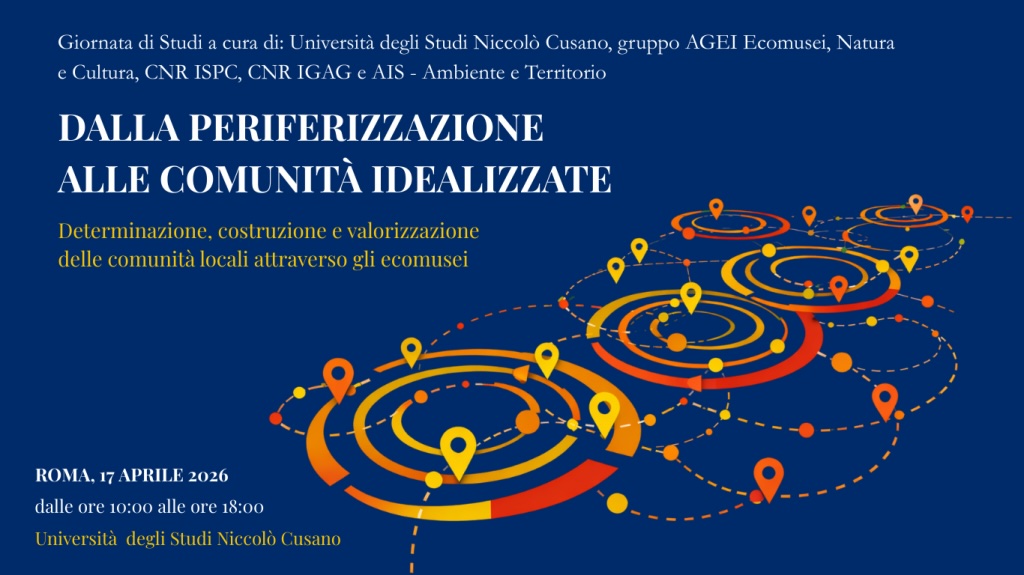
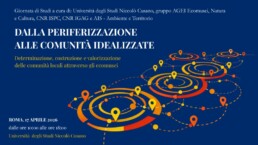
Dalla periferizzazione alle comunità idealizzate
Workshop Sguardi sul Patrimonio
17 April 2026
Università degli Studi Niccolò Cusano, Roma
The study day “Dalla periferizzazione alle comunità idealizzate. Determinazione, costruzione e valorizzazione delle comunità locali attraverso gli ecomusei” focused on the analysis of processes of peripheralization and on the ways local communities are defined, constructed, and enhanced, with particular attention to the role of ecomuseums as tools for community participation, place-based development, and social cohesion.
The conference offers a critical reflection on urban and peri-urban transformations, questioning traditional centre-periphery frameworks and addressing issues such as social inclusion, community participation, territorial identity, and the risks of idealizing or excluding certain groups within local heritage enhancement and development processes.
The initiative stems from the convergence of social geography, urban studies, and ecomuseum research, with the aim of exploring how communities are constructed, represented, and engaged in processes of territorial development and heritage enhancement.
The event was organized by Niccolò Cusano University in collaboration with the Institute of Heritage Science (ISPC) and the Institute of Environmental Geology and Geoengineering (IGAG) of the National Research Council of Italy (CNR), as well as the AGEI Research Group “Ecomusei, Natura e Cultura”.
Main publications
Romano A., Storace E., Ronchi D., Dalla Longa E., Ancient people and living nature: a global perspective on archaeological areas and biodiversity, People and Nature. DOI: http://doi.org/10.1002/pan3.70299
Dalla Longa E., Storace E., Romano A., Ronchi D. 2026, Archeologia e biodiversità: ripensare i siti archeologici come ecosistemi viventi per il futuro del pianeta, Convegno “Immaginare e costruire futuri sostenibili”, CNR DSU, 21.01.2026
Pietroni E., Bartalesi V., Bellia A., Calicchia P., Cerato I., Colesanti G., Concordia C., Dalla Longa E., D’annibale E., Demetrescu E., Dininno D., Chirivi’ A., Ferdani D., Fanini B., Greco E., Menconero S., Palama’ D., Palombini A., Pavone D.P., Ronchi D., Taloni M. 2026, PlaceMUS XR: Digital Journey across Musical Places in Europe and Extended Realities. Percorsi e luoghi della musica come ponte tra generazioni per trasmettere il patrimonio musicale europeo, Convegno “Immaginare e costruire futuri sostenibili”, CNR DSU, 21.01.2026
Dalla Longa E., Cerato I., Bonifazi F., Pietroni E. 2026, “Che cos’è per te patrimonio culturale?” – Una call di citizen awareness per promuovere il dialogo intergenerazionale, Convegno “Immaginare e costruire futuri sostenibili”, CNR DSU, 21.01.2026
Pietroni E., Dalla Longa E. (Authors), Cerato I. (Contributor) 2026, PlaceMUS XR and EU Cultural heritage: Preliminary Survey, Zenodo Dataset: https://doi.org/10.5281/zenodo.20068368