Reconstructing Embodied Musical Knowledge at the KEyboard
Acronym: REM@KE
Description
The project develops Cognitive and Digital Organology (CaDO), an interdisciplinary framework that integrates organology, cognitive science, artistic research, materials science, and acoustics to reconstruct the lost connections between historical keyboard instruments and the composers and performers who created music through them. The research outcomes will be made available in open access through the REM@KE portal, as well as through restored instruments and newly built scientific replicas intended to form a permanent research infrastructure.
The role of CNR ISPC
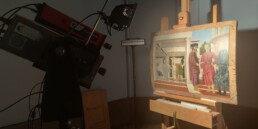
The Institute joins REM@KE thanks to its strategic contribution to the project's non-invasive diagnostics programme. As coordinator of E-RIHS.it, the Italian node of the European Research Infrastructure for Heritage Science (E-RIHS ERIC), CNR ISPC provides access to MOLAB (MObile LABoratory), a mobile laboratory platform dedicated to the in situ analysis of cultural heritage assets. Through a comprehensive suite of portable analytical techniques—including Raman spectroscopy, X-ray fluorescence, FTIR hyperspectral imaging, optical coherence tomography, UV/IR reflectography, X-ray radiography, and terahertz imaging—it will be possible to characterize materials, construction techniques, and conservation conditions directly within museum environments, without the need for sampling or moving the objects.
Within the framework of REM@KE, MOLAB will be employed to develop the CaDO documentation protocol for historical keyboard instruments. The analytical programme will generate the first systematic, multi-technique diagnostic dataset for this category of instruments, providing a robust scientific foundation for conservation and restoration decisions, historically informed physical reconstructions, and the development of their digital twins.
Project information
- Funded by: European Union – European Research Council (ERC)
- Call: ERC-2024-SyG – ERC SYNERGY GRANTS
- Grant Agreement n.101167101
- Start date: 1 September 2025
- End date: 31 August 2031
- ISPC Scientific coordinator: Costanza Miliani
- Project Leader: University of Pavia (PI: Prof. Massimiliano Guido)
- Partners: University of York (United Kingdom); University of Gothenburg (Sweden); Politecnico di Milano, Department of Electronics, Information and Bioengineering (DEIB), Cremona Campus, Musical Acoustics Laboratory (Italy).
- Funding: Total badget: € 8 031 361,00; Contribution to CNR ISPC € 250 000,00
- Website →

REM@KE is funded by the European Research Council (ERC) under the European Union’s Horizon Europe Research and Innovation Programme (Grant Agreement No. 101167101). The views and opinions expressed are solely those of the authors and do not necessarily reflect those of the European Union or the European Research Council. Neither the European Union nor the European Research Council can be held responsible for them.
News & Eventi

NEWS
REM@KE si amplia: CNR ISPC e Politecnico di Milano entrano come nuovi beneficiari del Synergy Grant ERC
Due istituzioni di ricerca italiane di rilievo internazionale rafforzano il nucleo scientifico del progetto per la ricostruzione della conoscenza musicale incarnata nello strumento a tastiera storico.
CREMONA | PAVIA — Il progetto ERC Synergy Grant REM@KE (Reconstructing Embodied Musical Knowledge at the KEyboard, grant n. 101167101) annuncia oggi l’integrazione formale di due nuovi beneficiari: l’Istituto di Scienze del Patrimonio Culturale del Consiglio Nazionale delle Ricerche (CNR ISPC) e il Dipartimento di Elettronica, Informazione e Bioingegneria del Politecnico di Milano (PoliMI-DEIB), rappresentato dal suo Laboratorio di Acustica Musicale presso il Polo territoriale di Cremona. Le due istituzioni si affiancano al consorzio già costituito dall’Università di Pavia (PI corrispondente: Prof. Massimiliano Guido), dall’Università di York (PI: Prof. Andrea Schiavio) e dall’Università di Göteborg (PI: Prof. Joel Speerstra).

Follow REM@KE on social media
For further information on the research topic, visit our Groups & Labs