
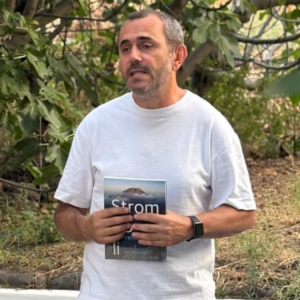
Professional profile
Archaeologist | Field Researcher | Data Re-user | Quantitative Archaeology | Mediterranean Protohistory
He is an archaeologist specializing in the study of Mediterranean Protohistory, with a particular interest in cultural processes, social organization, and the relationships between humans and the environment. His work lies at the intersection of field research and methodological reflection, with the aim of understanding how archaeological knowledge is constructed from heterogeneous material evidence, often fragmentary and shaped by long and complex research histories.
His scientific activity is grounded in the idea that archaeology is an intrinsically cumulative discipline, based on the critical reuse of data produced by successive generations of researchers. Within this framework, his research combines fieldwork, carried out through excavation projects and territorial analyses, with the systematic re-examination of legacy data, involving their enrichment, critical reassessment, and new analyses driven by updated research questions.
His work in the Aeolian archipelago provides a clear example of this approach. Since 2009, he has co-directed the excavation of the Bronze Age site of San Vincenzo on Stromboli; he is Principal Investigator of the Minority Report project, devoted to the reanalysis of data collected during twentieth-century excavations at Early Bronze Age sites on the archipelago’s “minor islands”; and he is Principal Investigator of the DALI project, which focuses on reassessing the absolute chronology of the stratigraphic sequence of the Acropolis of Lipari. These projects are complemented by research in continental contexts, such as investigations at the site of Monte Croce Guardia and in the Po Plain, where patterns of settlement, mobility, and land use are explored.
A transversal axis of his research concerns the relationship between human communities and the environment, examined through the study of settlement choices, spatial organization, and strategies of adaptation to different ecological contexts. From this perspective, the landscape is not conceived as a passive background to human action, but as an active component in the construction of the historical and social trajectories of Protohistoric communities.
From a methodological standpoint, he focuses on the formalization and integration of complex archaeological data, particularly through the use of geographic information systems, relational databases, and quantitative approaches. These skills are not conceived as an autonomous technical domain, but as research tools that make interpretative choices explicit and expand the analytical potential of the data. In this sense, the use of models, statistics, and network analysis does not diminish the interpretative dimension of archaeology, but rather increases its epistemological responsibility.
Alongside his research activity, he is continuously engaged in university teaching and training, understood as an integral part of scientific work. Teaching and collaboration with students and early-career researchers represent a privileged space for the critical transmission of methods, as well as for intergenerational dialogue on the aims and meaning of doing archaeology today.
Finally, his work is informed by a broader reflection on the conditions and purposes of contemporary archaeological practice: why and how we produce data, which forms of knowledge are enabled or obscured by our methodological choices, and the responsibilities that follow from them. Research is thus conceived not only as the production of results, but as an ongoing exercise in clarifying tools, limits, and scientific responsibilities.
CNR Disciplinary Fields and Research Management Sectors
- SH6_2 Prehistoric archaeology, archaeology of non-literate societies
- SH6_6 Digital, computational, virtual and geospatial archaeologies
- SH6_1 Archaeological methods and theory, history of archaeology
MUR Italian Scientific-Disciplinary Sector
- ARCH-01/A Prehistory and Protohistory
Groups & Labs CNR ISPC
Prehistory and Protohistory Research Group →
Modelling Archaeo Data Gruppo di Ricerca →