
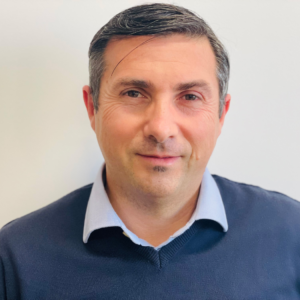
Professional profile
Software Engineer | Digital Heritage Specialist | Research Infrastructure Engineer | Data Analysis | IoT Systems Expert
His work focuses on the application of digital technologies to cultural heritage and on the design of digital infrastructures supporting scientific research.
A Computer Engineer (pre Bologna system) with a Ph.D. in Information Engineering obtained in 2005 from the University of Salento, he further strengthened his academic background through international certifications in project and IT service management, including PRINCE2® Foundation in Project Management, ITIL® Foundation in IT Service Management, Cisco DevNet Associate 1.0, and PCAP – Programming Essentials in Python.
His professional experience spans both academic and industrial research, with a specialization in the full life cycle of ICT services: from requirements analysis and solution modelling to technological architecture design, and finally to the operational implementation of systems. A recurrent theme throughout his career is technology transfer—transforming research outcomes into operational digital solutions for scientific and institutional communities.
In the context of infrastructure management, he is responsible for the operational datacenter in Lecce of E RIHS.it, the Italian node of the European Research Infrastructure for Heritage Science (E-RIHS), and he coordinates the "DIGILAB Hardware Platform" Working Group, overseeing operational maintenance of the E-RIHS.it datacenters, the design of federation mechanisms, and support for the deployment of applications on its clusters.
In the field of digital environments for Heritage Science, he has developed expertise in:
- defining architectures, services, and socio technical models for the access, management, and interoperability of Heritage Science data within the development of DIGILAB.it, the Italian node of E RIHS;
- designing platforms for the collection, visualization, and analysis of microenvironmental data used for monitoring and preventive conservation of cultural heritage;
- ensuring data interoperability in alignment with Open Science principles, semantic interoperability, and FAIR data standards;
- developing vertical applications that provide the Heritage Science community with digital access to specialized content.
He is co author of more than 60 scientific publications in international conferences and of the book Designing Complex Web Information Systems: Integrating Evolutionary Process Engineering (Information Science Reference, 2009, ISBN: 978 1 60566 300 5).
CNR Disciplinary Fields and Research Management Sectors
- SH8_1 Science and Technologies for Cultural Heritage
- IR Management of Research Infrastructures, Laboratories and Facilities; Digital Technologies for Research or Other Structures with Scientific Purposes
- PE6_3 Software Engineering, Programming Languages and Systems
MUR Italian Scientific-Disciplinary Sector
- IINF-05/A Information processing systems
Groups & Labs CNR ISPC
Digital Heritage Innovation Lab →
Publications
Highlight
A. Bucciero, A., Chirivì, A., Colella, R., Emara, M., Greco, M., Jaziri, M. A., Muci, I., Pandurino, A., Taurino, F. V., & Zecca, D. (2026). IoT-Based Platform for Wireless Microclimate Monitoring in Cultural Heritage. Heritage, 9(2), 57. DOI: https://doi.org/10.3390/heritage9020057
A. Chirivì, A., Pietroni, E., Greco, M., Pandurino, A., & Bucciero, A. (2026). An evolving scenario in the study of illuminated manuscripts: innovative approaches to research questions. Digital Applications in Archaeology and Cultural Heritage, 40, e00496. DOI: https://doi.org/10.1016/j.daach.2026.e00496
A. Bucciero, A., Chirivì, A., Ferrari, I., Giuri, F., Greco, M., Pandurino, A., Pescarin, S., Scardozzi, G., Taurino, F. V., & Zecca, D. (2025). Il Museo Archeologico di Ugento fra valorizzazione e fruizione [JB]. Archeologia e Calcolatori, 36(1), 375–392. DOI: https://doi.org/10.19282/ac.36.1.2025.19