Energy-SHARing solutions and communities for enhanced ENergy efficiency in Mediterranean historic centres
Acronym: SHAREN
Description
The building sector has a significant environmental and climate impact in Europe: it accounts for 40% of the energy consumption and represents 36% of the energy related GHG emissions. Decarbonising the EU building stock is key to limit the EU’s environmental impact. Not only is it necessary to improve energy efficiency but it is also essential to improve the part of renewable energies in the energy mix, with the long-term goal of achieving climate neutrality by 2050. Furthermore, in the current geopolitical context, the energy autonomy of Europe has become more important than ever. To reduce our dependence on fossil energies such as gas or petroleum, improving the green transition of buildings’ energy consumption towards renewable sources is of the utmost importance. Energy-sharing solutions and Renewable Energy Communities, introduced to empower citizens in collaboratively producing, sharing, and managing energy resources locally, are becoming an effective and economically efficient way to foster renewable energy technologies and community participation.
The energy and environmental improvement of historical buildings and neighbourhoods is even more complex. The challenge lies in striking a balance between modern energy transition standards and the need to protect the architectural and historical value of these buildings. Historic buildings often have special protection status due to their architectural and historical significance, and the concerns about the impact of energy efficiency and production measures have slowed down the integration of conservation and sustainable design practices, e.g., hindering the application of typical renewable energy solutions.
The great number of historic cities around the Euro-Mediterranean region calls for special attention. Rapid and unplanned development of urban areas, coupled with the increasing impacts of climate change, has caused a fast decline of many historic city centres, raising concerns on the state of conservation of this unique cultural heritage and the identity of the Mediterranean region. To revitalise Mediterranean historic centres, energy sharing solutions contribute to contrast energy poverty in historic areas and to strengthen community engagement through historical and cultural identity. Additionally, providing renewable energy to historic centres, they can also offer environmental, economic and social benefits, improving the overall quality of life in these areas by promoting green transition, economic stability and community well-being.
As part of the Interreg NEXT MED Programme, the SHAREN project aims at leveraging the potential of energy-sharing solutions to address the energy needs of historic centres in the Med area. Building upon the core concepts aestethics, sustainability and inclusiveness of New European Bauhaus, the project is tailored to facilitate the transfer of clean and renewable energy to historically significant locations without compromising their cultural heritage through renewable energy communities and energy sharing solutions. These solutions will be developed and tested by SHAREN pilots in Spain, Lebanon, Jordan, Türkiye and Italy.
Calcerano, Filippo, Letizia Martinelli, e Elena Gigliarelli. Chapter 11 – Heritage building information modeling and building performance simulation for solar design in built heritage. In Solar Energy Technologies in Cultural Heritage, a cura di Elena Lucchi. Elsevier, 2025.
Calcerano, Filippo, Stavroula Thravalou, Letizia Martinelli, Kristis Alexandrou, Georgios Artopoulos, e Elena Gigliarelli. Energy and Environmental Improvement of Built Heritage: HBIM Simulation-Based Approach Applied to Nine Mediterranean Case-Studies. Building Research & Information, pubblicazione online ad accesso anticipato, Routledge, 2023. world.
Gigliarelli, E., F. Calcerano, L. Martinelli, G Artopoulos, S. Thravalou, e K. Alexandrou. Methodology for the Energy Renovation of Heritage Buildings Using BIM. CNR edizioni, 2022.
Verticchio, Elena, Filippo Calcerano, Letizia Martinelli, e Elena Gigliarelli. Building Energy Modelling for Historical Buildings: Current Distribution of Literature Case Studies in View of Climate Change. Procedia Structural Integrity, ESICC 2023 – Energy efficiency, Structural Integrity in historical and modern buildings facing Climate change and Circularity, vol. 55 (gennaio 2024): 1–8.
Project information
- Funded by: European Union
- Call: Interreg NEXT MED Programme – First Call for Standard Projects
- Start date: 20 September 2025
- End date: 19 September 2028
- ISPC Scientific coordinator: Elena Gigliarelli
- Project Leader: Instituto Valenciano de la Edificación, Fundación de la Comunidad Valenciana (Spain)
- Partners: Lebanese Center for Energy Conservation (Lebanon); T.R. Ministry of Environment, Urbanization and Climate Change / General Directorate of Construction Affairs (Türkiye); Alternative Energies Generation Generación de Energías Alternativas, S.L.U. (Spain); Royal Scientific Society – National Energy Research Center (Jordan)
- Budget: € 2.519.303,28


Events & News
SHAREN officially launches in Valencia to promote energy-sharing solutions in Mediterranean historic centres
12 November 2025 | Valencia
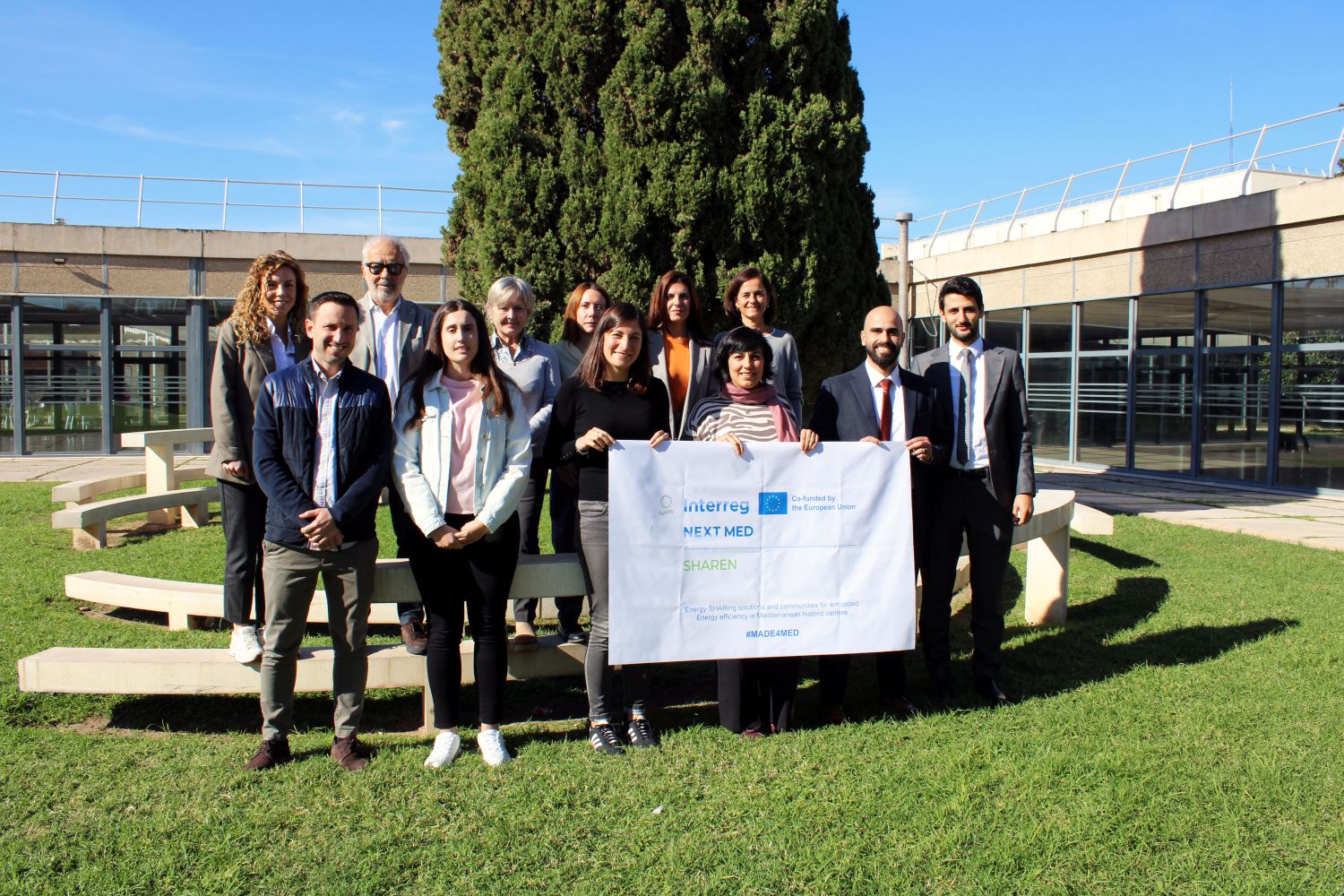
The SHAREN project – Energy-SHARing solutions and communities for enhanced energy efficiency in Mediterranean historic centres – has officially commenced following the celebration of its Kick-off Meeting in Valencia (Spain) on 11 and 12 November 2025. The event marked the formal start of a three-year initiative aiming to advance the energy transition in heritage urban areas across the Mediterranean.
Historic centres across the Mediterranean face the dual challenge of preserving their architectural and cultural heritage while responding to the need for cleaner, more efficient energy systems. Although the region benefits from excellent conditions for renewable energy, the integration of solar technologies often encounters limitations due to heritage protection requirements.
SHAREN seeks to bridge this gap by promoting Energy Sharing Solutions (ESS), including Renewable Energy Communities (REC). These models bring together municipalities, local businesses and residents to jointly generate, share and consume clean energy. This approach enables heritage buildings to benefit from nearby renewable energy production without altering their visual identity, while also improving energy efficiency, strengthening supply security, empowering citizens and reducing energy poverty.
The project is led by the Valencia Institute of Building (IVE) and brings together key institutions from six Mediterranean countries:
- Lebanese Center for Energy Conservation (LCEC) – Lebanon
- Ministry of Environment, Urbanization and Climate Change – Türkiye
- Enercoop Group – Spain
- National Research Council (CNR ISPC) – Italy
- Royal Scientific Society (RSS–NERC) – Jordan
For further information


Follow SHAREN on social media
For further information on the research topic, visit our Groups & Labs