Closing a knowledge gap by vocational training about satellite-based services in cultural heritage preservation
Acronym: SATCULT
Description
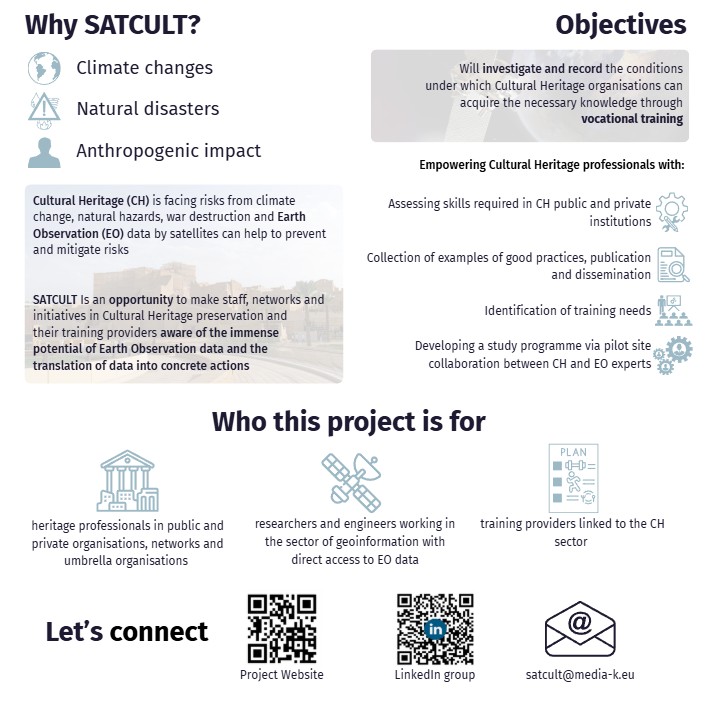
SATCULT promotes vocational training on satellite data usage for the protection of cultural heritage, addressing climate change and war-related risks. The project identifies training needs, compiles good practices, builds a pool of experts, and enables capacity building. The 18-month project brings together three key partners: media k GmbH (Germany, coordinator), CNR ISPC (Italy), and the Eratosthenes Centre of Excellence (Cyprus).
Project information
- Funded by: European Union
- Call: KA210-VET – Small-scale partnerships in Vocational Education and Training (2024, Round 1)
- Start date: 1 December 2024
- End date: 31 Mat 2026
- ISPC Scientific coordinator: Nicodemo Abate
- Project Leader: media k GmbH (Germany)
- Partners: ERATOSTHENES Centre of Excellence (Cyprus)
- Funding: € 60.000
- Website →
- Brochure →

SATCULT has received funding from the European Union’s Erasmus+ Programme, KA210-VET Call (Small-scale partnerships in vocational education and training), Form ID KA210-VET-726E31AF.

News & Eventi
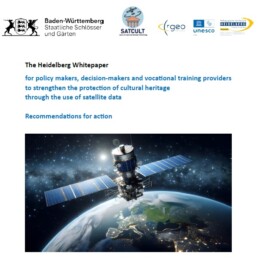
Heidelberg Whitepaper
Recommendations for action
For policy makers, decision-makers and vocational training providers to strengthen the protection of cultural heritage through the use of satellite data
The Heidelberg Whitepaper summarises the results of the workshop “Cultural Heritage Protection From Space: Potentials of Using Satellite Data”, held in Heidelberg, Germany, on 23 September 2025. The initiative was promoted, planned, and carried out within the framework of the European SATCULT project, in cooperation with State Palaces and Gardens Baden-Württemberg and the UNESCO Chair for Earth Observation and Geocommunication of World Heritage Sites and Biosphere Reserves (Department of Geography – Research Group for Earth Observation at the Heidelberg University of Education).
The document is aimed at policy makers (politicians and members of public bodies dealing with the protection of cultural heritage and related fields), decision-makers in the areas of cultural heritage protection and geoinformation, and training providers active in these fields.
The Heidelberg Whitepape articulates seven demands:
- Strengthening and encouraging cultural heritage institutions to use satellite data
- Encouraging the geoinformation sector to collaborate with the cultural heritage sector
- Networking between the cultural heritage sector and the geoinformation sector
- Promoting practice-oriented application projects
- Preparing information tailored to specific target groups
- Promoting knowledge transfer
- Improving coordination at the national level
Take part in the SATCULT Survey
Deadline: February 28th, 2026
Help shape future training for using Earth Observation and satellite data for the protection of cultural heritage, addressing climate change and war-related risks.
Who is it for?
Cultural heritage managers
The survey aims to identify the needs of cultural heritage managers in the use of Earth observation and satellite data including the access, the analysis and the implementation of measures.
Geoinformation experts
The survey is aimed at geoinformation experts to find out under what conditions and circumstances they would be willing to support cultural heritage managers in the use (access, analysis, implementation) of Earth observation and satellite data.
Why participate?
Your input will guide the creation of tailor-made qualification programmes for better integration of Earth Observation data in cultural heritage protection.
Join now and make an impact!

SATCULT Survey | Italiano
Per i gestori del patrimonio culturale →
Per gli esperti di geoinformazione →
SATCULT Survey | English
For cultural heritage managers →
For geoinformation experts →
SATCULT Survey | German
Für Beschäftigte im Kulturgüterschutz →
Für Beschäftigte in der Geoinformation →
Follow SATCULT on social media
For further information on the research topic, visit our Groups & Labs