
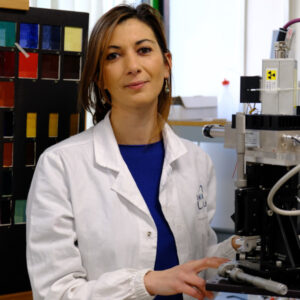
Professional profile
X-ray Spectroscopy Specialist | Mobile X-ray–based Technologies Developer
Senior researcher in the field of X-ray spectroscopy, with a specific focus on imaging techniques for the non-invasive physico-chemical characterization of cultural heritage materials from the micro- to the macroscale.
Since 2014, she has been working at the CNR ISPC XRAYLab where she leads research activities dedicated to the conception, design, development, and application of innovative X-ray methodologies and advanced mobile instrumentation operating directly within museums, archaeological sites, and conservation centers. Her technological activity is aimed at the development of systems characterized by high chemical sensitivity, high spatial resolution, and real-time data acquisition capabilities.
She obtained her Master’s degree in Nuclear Physics cum laude from the University of Catania in 2012. In 2013, she conducted research at the Physics Laboratory of Columbia University (New York, USA) as a staff-associate researcher. In March 2017, she was awarded a PhD in Physics cum laude from the University of Catania, with a dissertation focused on the development of a macro-X-ray fluorescence (MA-XRF) imaging system for the analysis of large-scale paintings with high spatial resolution and high scanning speeds. Within several research infrastructure projects, she has made significant contributions to the advancement of state-of-the-art mobile X-ray imaging techniques, including MA-XRF, micro-XRF, confocal XRF (CXRF), full-field XRF (FF-XRF), grazing-emission and grazing-incidence XRF (GE-XRF/GI-XRF), and XRD imaging.
Between 2016 and 2026, she has participated in more than 60 in situ diagnostic campaigns, many of which were conducted under her scientific responsibility or coordination, in collaboration with internationally renowned museums and conservation institutions, including the Egyptian Museum of Turin, the National Archaeological Museum of Athens, the Museo e Real Bosco di Capodimonte, and the Fitzwilliam Museum in Cambridge. Her research has addressed archaeological materials and major works of art of outstanding significance, including the carbonized Herculaneum papyri, the frieze of the Tomb of Philip II, the funerary assemblage of the Egyptian tomb of Kha and Merit, and masterpieces by Leonardo da Vinci, Raphael, Botticelli, and Caravaggio, contributing to a deeper understanding of artistic techniques, material composition, and creative processes.
She is co-author of 50 peer-reviewed publications and is actively involved in competitive national and European research projects, including PNRR and Horizon 2020 programmes, playing a significant role in technological innovation and the strengthening of research infrastructures.
She collaborates with the MOLAB platform, part of the Italian node E-RIHS.it of the European Research Infrastructure for Heritage Science (E-RIHS), providing national and transnational access to advanced mobile X-ray instrumentation for the international Heritage Science community.
She has delivered invited keynote lectures at major international conferences, including MA-XRF 2022 and EXRS 2024, and has presented numerous oral contributions at conferences such as TECHNART. She is a member of the scientific committee of the conference “Macro X-ray Fluorescence Scanning in Conservation, Art and Archaeology” and is also engaged in advanced academic training through PhD-level teaching and seminars at specialized schools.
CNR Disciplinary Fields and Research Management Sectors
- SH5 Cultures and Cultural Production
- PE4 Physical and Analytical Chemical Sciences
MUR Italian Scientific-Disciplinary Sector
- PHYS-06/A Physics for Life Sciences, the Environment, and Cultural Heritage
- CHEM-01/B Environmental and Cultural Heritage Chemistry
Groups & Labs CNR ISPC
XRAYlab →