
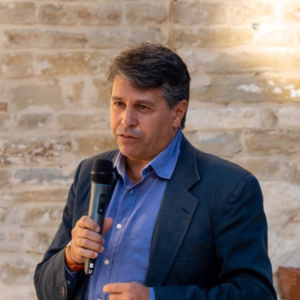
Professional profile
Archaeologist | Landscape Archaeology | Remote Sensing Specialist | Ancient Topography | Archeological Mapping Specialist | Archaeological Survey
Researcher at CNR ISPC and Adjunct Professor at the University of Florence, where he teaches Survey and Technical Analysis of Ancient Monuments and Archaeological Aerial Photo-Interpretation at the School of Specialisation in Archaeological Heritage.
He holds a degree in Ancient Topography from Sapienza University of Rome (1992), a specialisation in Reading and Interpretation of Aerial Photographs from the Italian Air Force School (1994), and a PhD in Ancient Topography (2006).
His research focuses on ancient topography, settlement dynamics, ancient urbanism, and road networks, with strong expertise in aerial photography, photogrammetric survey, and digital archaeological cartography (GIS and CAD). His work integrates field survey, instrumental and photogrammetric documentation of ancient monuments, and advanced spatial analysis.
He specialises in terrestrial and UAV-based photogrammetry and in remote sensing, applying multi-temporal analysis of historical, UAV, and satellite imagery to detect archaeological features at multiple spatial scales and to reconstruct ancient urban layouts. His research combines fieldwork with the study of ancient literary and epigraphic sources, historical cartography, and published and unpublished datasets.
His main research areas include the Etruscan city of Vulci and its territory, the Via Aurelia and associated road systems, the Archaic necropolis of Plestia (Colfiorito, Foligno), and Roman centuriation in Florence, Pisa, and Pavia. From 2019 to 2023, he was Director of graphic and photogrammetric documentation for the Roman amphitheatre of Volterra.
His research in the San Casciano dei Bagni area contributed to the archaeological investigations that led to the discovery of the well-known sanctuary.
He is Scientific Coordinator of “VELATHRI Immersiva”, a project focused on the enhancement of the acropolis of Volterra through augmented and virtual reality technologies (funded by the Tuscany Region), and of “Hidden Landscape of Latium” (HiLL), a multidisciplinary PRIN 2022 project on the diachronic reconstruction of settlement patterns within the Presidential Estate of Castelporziano, in collaboration with the Universities of Florence and Siena.
CNR Disciplinary Fields and Research Management Sectors
- SH6_3 Archaeology of early literate societies and early civilizations
- SH6_6 Digital, computational, virtual and geospatial archaeologies
MUR Italian Scientific-Disciplinary Sector
- ARCH-01/F Ancient Topography
Groups & Labs CNR ISPC
Archaeology and Environment Research Group →
Heritage Materials Science Lab →
Archaeological Mapping Lab →
Publications
Highlight
G.F. Pocobelli (2024). Vulci: l’area urbana e il suburbio. Evoluzione storica della città e del territorio. L’Erma di Bretschneider. ISBN 9788891332837; DOI: https://doi.org/10.48255/2283-3366.ATTASup.24.2023
G.F. Pocobelli (2024). La centuriazione ad est di Firenze. Nuovi spunti di ricerca dalle immagini aeree, in S. Valentini, G. Guarducci, V. Santini (eds), Archeologia in Toscana. Ricerca, Tutela, Gestione, Valorizzazione (Atti del Convegno. Firenze, 7-9 Giugno 2023), pp. 445-456. Arbor Sapientiae Editore. ISBN 9791281427174.
I. Cacciari, G.F. Pocobelli (2021). The contribution of artificial intelligence to aerial photointerpretation of archaeological sites: a comparison between traditional and machine learning methods, in Archeologia e Calcolatori 32.1, pp. 81-98. All’insegna del Giglio. ISSN 1120-6861; e-ISSN 2385-1953; DOI: https://doi.org/10.19282/ac.32.1.2021.05